




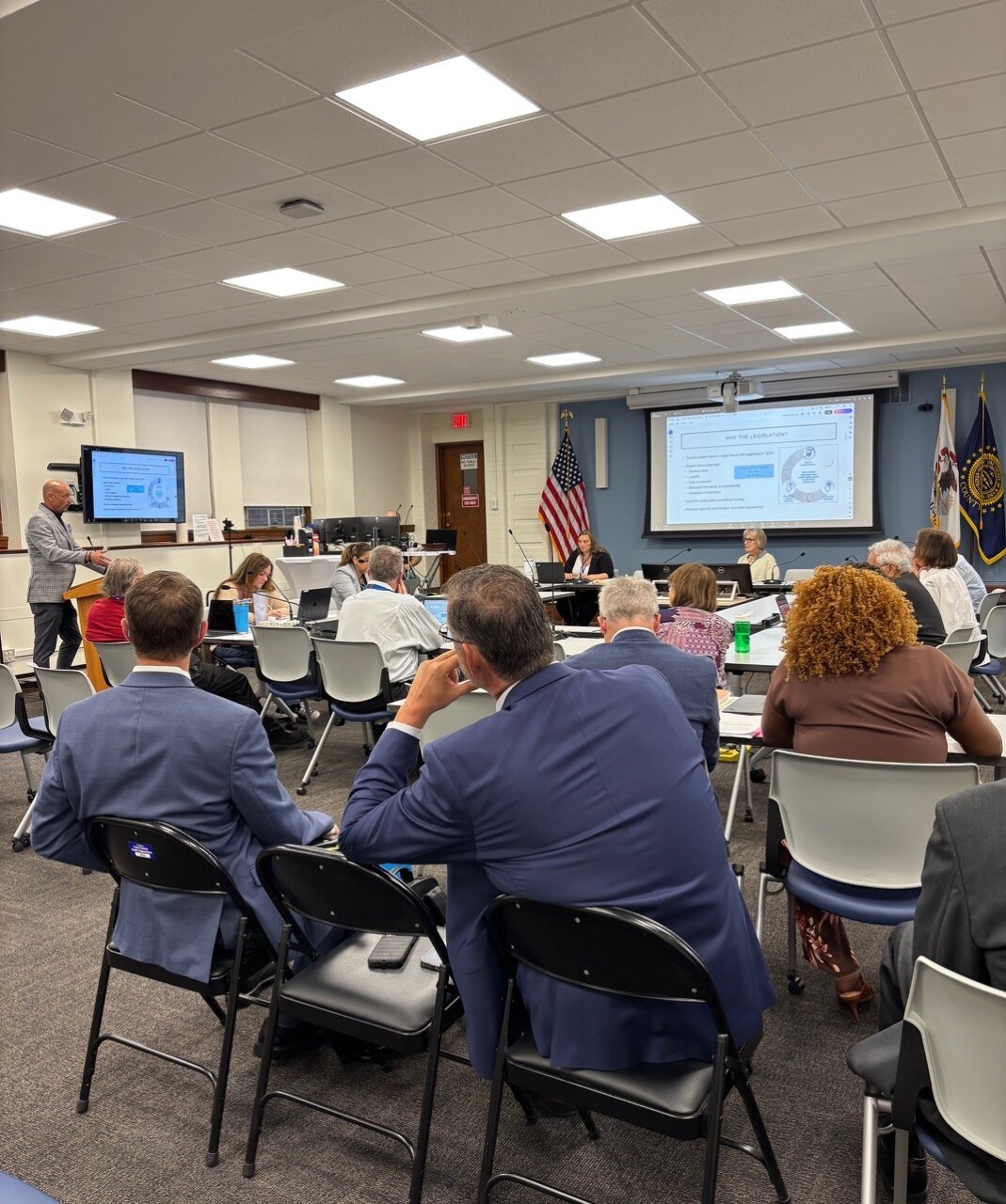
Kane County Board Members Examine Impact of New Transit Governance Structure
A sweeping overhaul of northeastern Illinois' transit system could have important implications for future transportation planning, development and funding in Kane County.
Heidi Files, Chief of Planning and Programming for the Kane County Division of Transportation, along with transit officials and advocates, recently briefed the Kane County Board's Committee of the Whole on the Northern Illinois Transit Authority (NITA) Act, legislation signed into law in December 2025 that took effect June 1.
The law was designed to address a projected fiscal crisis facing the region's transit systems. Following changes in ridership patterns after the COVID-19 pandemic, regional transit agencies faced an estimated $834 million funding shortfall by 2027. Without intervention, officials warned the region could face fare increases, service reductions, staffing cuts and declining service reliability.
One of the most significant changes is the transition from the Regional Transportation Authority (RTA) to the Northern Illinois Transit Authority (NITA), which will serve as the region's primary oversight and coordination agency. Metra, Pace and the Chicago Transit Authority (CTA) will continue operating transit services.
Kane County will continue to have a voice in regional transportation decisions, though its representation will change under the new structure. Currently, the county has three separate appointments, one each to the Regional Transportation Authority (RTA), Pace and Metra boards. Under the NITA Act, Kane County will have one dual appointment serving on both the NITA and Pace boards, along with one appointment to the Metra Board.
Under the new law, NITA gains expanded authority over regional transit planning, fare integration, capital investment priorities, service standards, funding distribution and safety coordination. The legislation also creates new regional initiatives focused on rider safety, law enforcement coordination, integrated fare systems and ADA mobility services.
The law also authorizes NITA to partner with public and private entities on transit-supportive development projects designed to place housing, jobs and community amenities near transit facilities. County officials said those provisions could influence future development and transportation planning in Kane County, including pedestrian improvements, ADA accommodations, shelters and boarding areas near transit corridors. The law also includes provisions commonly known as the "People Over Parking Act," which limits minimum parking requirements for developments near rail stations and major bus routes to encourage walkable, transit-oriented communities.
The law also requires greater collaboration among NITA, the Illinois Department of Transportation, the Illinois Tollway and local governments on projects involving Bus Rapid Transit, transit technologies and other mobility improvements. Officials said the changes could create opportunities for innovative transportation solutions in Kane County, including future bus-on-shoulder operations along tollway corridors.
The legislation establishes approximately $1.2 billion in new annual regional transit funding beginning in 2027, aimed primarily at stabilizing transit operations and maintaining service levels throughout northeastern Illinois.
According to projections presented to the County Board, the new revenue will come from several sources, including an estimated $520 million annually from an approved 0.25% increase to the RTA sales tax, which takes effect August 1, 2026. Additional revenue is expected from the state's sales tax on motor fuel, estimated at $670 million to $731 million annually, and from road fund interest revenues, projected to generate between $165 million and $180 million for transit capital improvements.
Most of the new funding is intended to support transit operations, while road fund interest revenues will primarily be directed toward capital investments and infrastructure improvements.
The NITA Act will gradually shift transit funding away from fixed formulas and toward allocations based on performance, ridership, service demand and mobility needs. Officials said the changes could make future funding discussions increasingly important for Kane County and other collar counties.
Staff told board members they will continue monitoring implementation of the new law and coordinating with regional partners, including Pace, Metra, regional transit representatives and transportation working groups. Future discussions are expected to focus on service standards, funding formulas, board appointments and the long-term impact on Kane County transportation services.
Watch the entire meeting on the Kane County Government YouTube channel:
https://www.youtube.com/watch?v=qvAVwUnEjM8